How Long Should a Water Heater Last in a Coastal Home?
The general industry guidance for water heater lifespan is straightforward: a traditional storage-tank unit typically lasts 8 to 12 years, while a tankless system can reach 15 to 20 years with proper maintenance. But those figures assume average conditions — and coastal Hermosa Beach is anything but average when it comes to factors that affect plumbing equipment. Salt air, mineral-laden water, and the demands of beach-house living all work together to push water heaters toward the shorter end of that range, sometimes shorter still.
Understanding why coastal conditions are hard on water heaters, and what you can do to counteract them, can save you from a cold-shower surprise or — worse — a leaking tank that damages your floors and walls before you notice anything is wrong.
The Role of Mineral Buildup in Water Heater Deterioration
The water supply in the South Bay region carries dissolved calcium and magnesium — what most people know as "hard water." Inside a storage-tank water heater, these minerals don't stay dissolved. As the water heats up, calcium carbonate and magnesium compounds precipitate out and settle at the bottom of the tank, forming a layer of sediment that gradually grows thicker over time.
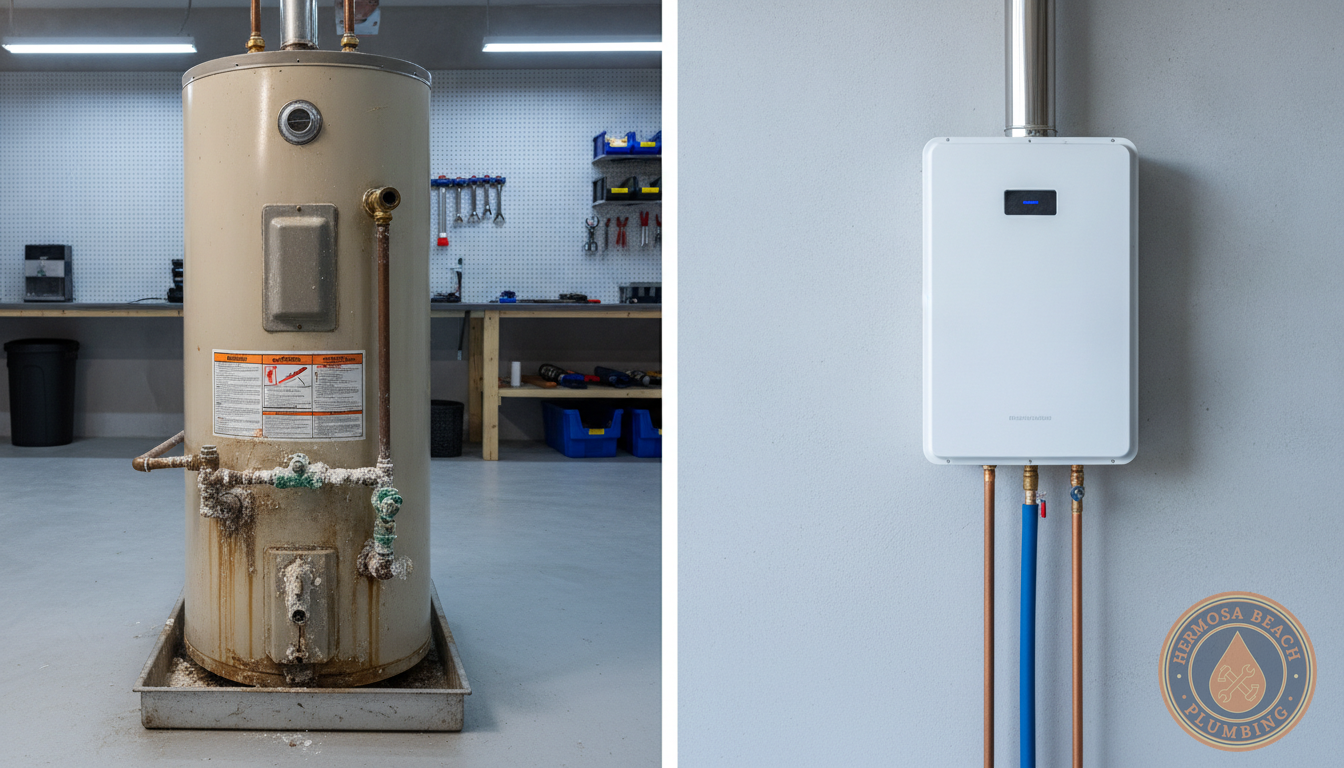
That sediment layer creates several problems simultaneously. First, it acts as an insulating barrier between the burner (in gas units) or heating element (in electric units) and the water in the tank, forcing the heater to run longer and work harder to reach the set temperature — which increases your energy bill. Second, as the burner heats the sediment layer directly, the steel tank floor beneath it experiences thermal stress that accelerates corrosion and can lead to pinhole leaks or full tank failure. Third, the popping and rumbling sounds that many homeowners report from older water heaters are caused by water trapped under the sediment layer boiling and bubbling — a sign that the unit is working far harder than it should.
Annual sediment flushing is the single most effective maintenance step for extending the life of a tank-style water heater. During a flush, a technician connects a hose to the drain valve and empties the tank, carrying the accumulated sediment out with the water. This simple procedure, which typically takes under an hour, can add years to your unit's service life and improve its energy efficiency noticeably.
Salt Air and Exterior Corrosion
If your water heater is located in a garage or utility room near the exterior of your Hermosa Beach home, it's exposed to a level of salt-laden air that inland units never encounter. Over time, this salt air attacks the exterior of the water heater, corroding the metal casing, the connections at the top of the tank, and any exposed fittings. While exterior cosmetic corrosion isn't immediately dangerous, heavy corrosion around supply connections or the pressure-relief valve outlet is a sign that those components need attention before they fail.
Tankless water heaters, which are mounted on walls and are far more compact than tank units, are increasingly popular in Hermosa Beach because they eliminate the standing water that fuels sediment buildup. However, they are not immune to mineral scaling — the heat exchangers inside tankless units can scale up over time if the unit isn't descaled periodically, reducing efficiency and eventually causing the unit to shut itself down on thermal overload.
Anode Rod Depletion: The Hidden Protection You Can't See
Inside every tank water heater is a component called a sacrificial anode rod — a long metal rod, usually magnesium or aluminum, that is designed to corrode in place of the steel tank walls. As long as the anode rod is intact and actively corroding, the tank itself is protected. But once the anode rod is fully consumed, the tank becomes vulnerable to rapid corrosion from within.
Most manufacturers recommend inspecting the anode rod every two to three years and replacing it when it has been significantly depleted. In practice, the mineral-rich water and heavy use patterns common in coastal homes can exhaust an anode rod faster than the manufacturer's timeline suggests. Many water heater failures that look like "sudden" tank failures are actually the predictable result of an anode rod that was never inspected or replaced.
This is one of the maintenance checks our technicians perform during a water heater service visit. If your unit is approaching mid-life and the anode rod has never been inspected, it's worth scheduling a check. A new anode rod is an inexpensive repair that can prevent a far more expensive early tank replacement.
Warning Signs Your Water Heater Needs Attention
Hermosa Beach homeowners should watch for these signs that a water heater repair or replacement may be needed:
- Rust-colored or discolored hot water — This indicates corrosion inside the tank and is a sign that the unit may be near the end of its serviceable life.
- Popping, rumbling, or banging sounds — These indicate heavy sediment buildup on the tank floor. A flush may resolve this if caught early, but severe buildup may mean the unit is already stressed beyond recovery.
- Inconsistent water temperature — If you notice your hot water running out faster than it used to, or the temperature fluctuating unpredictably, it could signal thermostat failure, element failure, or severe sediment insulation on the heating surface.
- Visible leaks or moisture around the base of the tank — Any water pooling under the unit should be investigated immediately. A small drip from a fitting is repairable; moisture seeping from the tank body itself usually means the tank has corroded through and needs immediate replacement.
- A unit over 10 years old in a coastal location — Even if it's still producing hot water, a unit in this age range in a Hermosa Beach home is statistically approaching failure. Having it assessed before it fails gives you time to plan a replacement on your schedule rather than in an emergency.
Repair or Replace? Making the Right Call
Not every water heater problem calls for replacement. A failed thermocouple on a gas unit, a burned-out heating element on an electric unit, or a leaking pressure-relief valve are all straightforward repairs that our technicians can typically complete in a single visit using parts carried on the service vehicle. If the unit is in good structural condition and under 8 years old, repair almost always makes more economic sense than replacement.
When the unit is older, or when the issue involves corrosion of the tank body, a failed anode rod that was never replaced, or a heat exchanger in a tankless unit that has been scaled beyond recovery, replacement becomes the more cost-effective path. Our technicians will give you an honest assessment of both options — including estimated repair cost versus the projected remaining useful life of the unit — so you can make an informed decision. Learn more about our full water heater repair and replacement services.
Thinking About Upgrading to Tankless?
The shift from a traditional storage-tank water heater to a tankless on-demand system is one of the most popular plumbing upgrades among Hermosa Beach homeowners right now. Tankless units provide continuous hot water without the standby heat loss of a storage tank, occupy a fraction of the wall space, and have longer service lives. For households with two or more bathrooms and active daily hot water demand, the energy savings can offset the higher upfront installation cost within a few years.
Tankless installation in an existing home requires more planning than a like-for-like tank swap. Gas tankless units require a larger gas supply line and dedicated venting, while electric models may require an electrical panel upgrade. Our team handles the full scope of a tankless conversion, including gas line sizing, venting, and any required permits, so the transition is smooth and code-compliant.
We Serve Hermosa Beach and Nearby South Bay Communities
Hermosa Beach Plumbing provides water heater repair and replacement throughout Hermosa Beach and the surrounding area. If you're in Manhattan Beach, Redondo Beach, or Lawndale and need a water heater assessment, we serve your neighborhood too. We're also available to help homeowners in El Segundo and Torrance with all water heater needs.
While you're planning your maintenance, it's also worth knowing that hidden pipe leaks near your water heater can contribute to moisture damage that's easy to miss. Our leak detection and pipe repair service uses acoustic equipment and moisture meters to find leaks behind walls and under floors before they cause serious structural damage.
To schedule a water heater inspection, flush, or replacement consultation, call Hermosa Beach Plumbing at (424) 449-0012 or email [email protected]. We're open every day of the week from 8 AM to 6 PM and are located at 703 Pier Ave Suite C, Hermosa Beach, CA 90254.
Need Service?
Call +14244490012 or fill out our online form for a free, no-obligation quote.
Request Free Quote